|
||||
|
Thursday, August 31
[10:48PM EDT]
If you have any suggestions about whom I should be talking to about oxygen (preferably here in Toronto, but not necessarily) be sure to drop me a note. My team is going to be spending the next 6 months making sure our customers can breathe. C (1) | T (55) | # Wednesday, August 30
[10:37AM EDT]
This is going to have to be quick. Not only am I behind on my email, but now I find myself in the strange position of being behind in my blogging as well. I've got a half-written followup for Marc - it basically says " I love you too man. Don't worry, I actually like it when you try to arm-twist me into doing strange things with my products. I just need to get better in understanding which of these strange things are going to be useful today vs. useful tomorrow." I also have a half-written followup on my Zoho analysis, which basically says “Don’t forget that my analysis was based on what a third party reviewer said and not on my first-hand observations about what the Zoho team is actually doing.” After hearing directly from the Zoho folks, I think they are much closer to the mark than what I originally estimated from Marshall’s commentary. I’ll need to keep that in mind the next time I want to blog first and ask questions later. I’m holding off on writing a posts about how shitty my mail service has been lately, the my bid in the upcoming CIRA election as well as how useless mobile devices actually can be in practice without total buy-in to one proprietary platform or another… First, I need to get through another 1457 email messages, do some corporate blogging over at the Domain Direct blog and figure out how to get a new sidewalk installed at Casa Disco. More soon. Promise. Now playing: "Forgiven" from the album "People" by Hothouse Flowers.
C |
T (18) |
#
Sunday, August 27
[01:30AM EDT]
the moneyback guarantee has cost us precisely 2% of revenues, which also includes chargebacks, credit card fraud, and people who accidentally ordered twice. That figure that has remained remarkably stable through the years and which I think is well worth it, but then again, I'm only measuring the cost, because the benefit is too hard to measure!I'm happy to find this tidbit. Offering a MBG has been high on my list for Tucows retail services since day one, but I've been hard pressed to find any real data about the impact of doing so - a classic case of my instincts pointing in a direction that isn't supported by anything observable. I'm glad Joel posted this, this will definitely make it easier for me to get us to take the plunge. C | T (15) | # Saturday, August 26
[04:35PM EDT]
Yesterday, Dan and I finally turned off the upgrade functions in Blogrolling. Now, everyone that signs up gets a Blogrolling Gold subscription for the same price that a regular subscription would have cost – i.e. $0. We did this mainly because we’ve lagged adding new features to Blogrolling.com while I tried to figure out how it fit into our business. Now that I’ve got a strong idea, I can justify the additional investment that we need to make to start introducing new features again. There’s more information on the Blogrolling blog… C | T (77) | #
[02:44PM EDT]
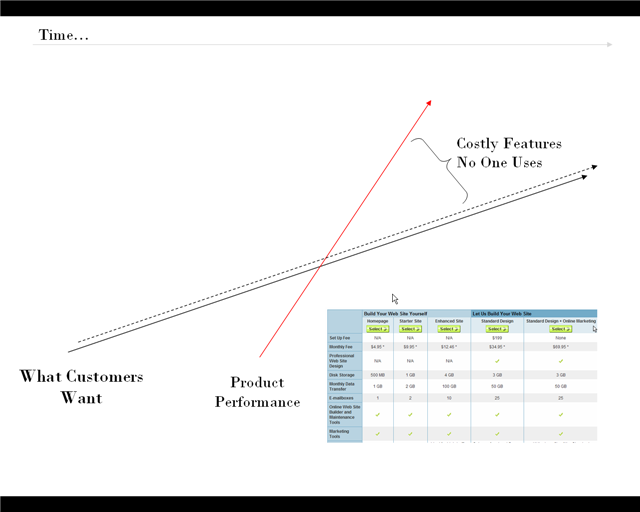
Something I read on TechCrunch this morning struck a particularly dissonant chord with me. Marshall Kirkpatrick writes; The Zoho team told me that if Basecamp targets “the less is more crowd,” ZohoProjects will be feature rich. It’s not there yet, but it sounds like a good strategy. Techcrunch – “ZohoProjects challenges Basecamp on project management”. I’m a long-time devotee of Clayton Christensen, so I couldn’t help but think “Wow – that is so *not* a good strategy…” Let me explain…(using my own versions of CC’s famous slides as illustration…)
37Signals appears to understand that if they want to sell Basecamp to a particular market segment with a particular set of needs that all they need to do is figure out exactly what those needs are and then build functions that deal exactly with those needs into their service. And that’s it. They don’t waste any time trying to understand what features those customers might need, what features their competitors think those customers need, what features they think those customers might find cool. No, they do eactly one thing – attempt to understand, at a very deep level, exactly which features and functions the desirable users need from a project management service and then build those features into their service.
Here’s my take on Christensen’s spin on why “Less-is-more” is smart (and profitable). Over time, customers needs will change. On the whole, these needs will grow greater as people become more familiar with the product you sell, and therefore demand more from it. What people are doing with computers today is drastically more sophisticated than what they were doing 5, 10 and 15 years ago.
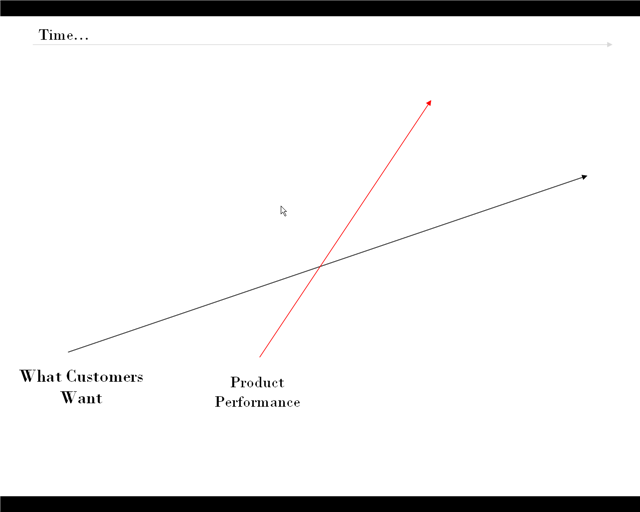
In response to this, producers will generally enhance their products to meet these requirements.
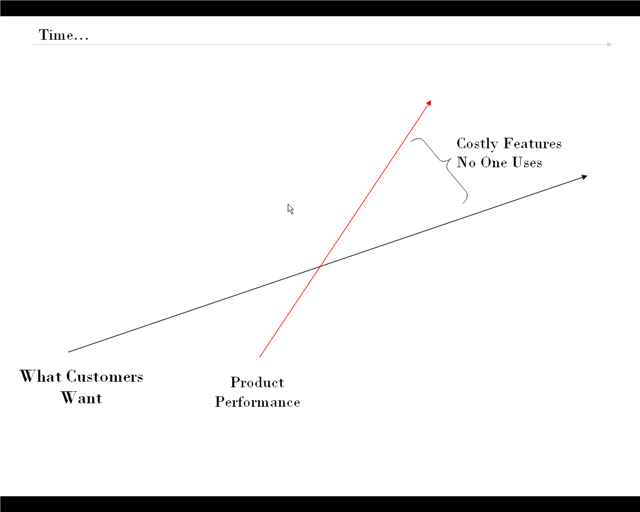
The problem is, due to a variety of competitive factors, the rate at which producers enhance the capability of their products exceeds the rate at which customers needs increase. The reason that this is a problem is that this leads to excess performance capabilities – i.e. features that customers do want and aren’t using.
Every additional product enhancement has a measurable cost for producers. Typically, a producer expects to recoup these costs by appealing to more paying customers, which has the net effect of generating more revenue for the producer. But, if new features that don’t appeal to enough users to pay for themselves have a negative effect on the profitability of the producer. The feature has ended up costing more to implement than it will generate in revenue. The only way to avoid this costly mistake is to figure out what problems the desirable customers are having and to solve the gnarliest of those problems with as little effort as possible. In the diagram below, this means figuring out how to plot the dotted line – how to stay just one step (not less, not more) ahead of where your customers need you to be.
So back to Zoho. I think these folks have a serious product strategy problem. They have defined their product in terms of what one of their competitors is doing (“We will have more features than Basecamp”) rather than in terms of what their customers can demonstrably digest. Worse. they’ve also defined their marketing message in terms of their product type (“Manage projects online”) instead of defining it in terms of what their customers are trying to achieve (“Collaborate more effectively”)
I have a lot of sympathy for software companies like Zoho and 37Signals. What they do is not easy. They have to be excellent at understanding their customers, excellent at designing software, and excellent at selling it. Complete focus is one of the most critical elements of achieving success. Which is where Marshall’s analysis of Zoho’s strategy falls apart. Zoho may have absolute focus on what’s important to them, but I’m not sure that they realize what’s really important. What 37Signals does, what Microsoft does, is one of the least important variables in their business. They can’t let 37Signals set the pace for them. Zoho needs to let their own customers set the pace. If they don’t, they are quite likely going to invest a lot of money building a lot of features that the majority of their customers will ever use. At the same time, 37Signals is pretty likely going to invest a lot of money in building high quality features that their customers will use. In the end, 37Signals will end up with a lot more customers than Zoho at a much lower overall cost, and Zoho customers are going to continually be tempted by Microsoft’s marketing onslaught. And that, in a very large nutshell is why more is actually less. Building more features than more of your competitors in an attempt to appeal to more customers requirements more money and more time, resulting in less profit. I really believe that less time spent building less features means less waste which means more customers, more happy customers and more profitable customers. Hopefully this makes more sense than less
C (1) | T (65) | # Thursday, August 24
[01:28PM EDT]
Dave Winer is talking about his "River of News" again....
My first river of news aggregator first appeared in 1999, when RSS was new. I've been doing them ever since. This was the week when the concept finally caught on, imho. I've said it before, and I'll say it again - this is the only way to read news. It liberates the reader from the shackles of folders of unread messages and very casually drops unread (and read) items off the bottom of the page. It is a very comfortable way to read news. So comfortable in fact that we made “River of News” the default view for both Skydasher and Skydasher: Mobile Edition (except we call it “sort by timestamp” – with the other view being “sort by source”).
Wednesday, August 23
[11:53PM EDT]
I tried to order a tshirt online tonight, but the ordering system kept failing because of an "AVS Error" X which basically means that the ordering system wasn't able to match the billing address that I supplied with the billing address the credit card company had on file for me. I literally tried everything I could think of to ensure that I was giving the ordering system the info it expected...to no avail. everything I tried failed with the same error. I'm pretty sure that the real problem was on their side not mine. I buy a fair amount of stuff online and I've never run into this problem before. if I had to guess, I would have to say that they ratcheted up the strictness of their credit card security checking waaayyy too high. This would have the effect of causung a failure for even the slightest difference between the information provided and the information on file. My problem doesn't lie with the fact that my credit card couldn't be processed, but rather that they didn't give me any clue about what I could do to get it processed. No phone number to call, no faq to read - nothing. I really want the shirt, but do I really want to chase it any more than I already have? I've made a note to double check what we do when to make sure our customers get some guidance when we throw up obstacles like this. C | #Sunday, August 20
|
Blogroll 2.0
Make a Donation to the Tour For Kids!
Twitterings
 Search
 "Random Bytes" is a produced for and by Ross Rader. Everything else is just a happy byproduct. The views expressed here belong to me and not my employer.. Contact Me
Feel free to use my contact information to get in touch for work related items. email: ross@tucows.com tel. +1.4165385492 cel. +1.4168288783 MSN. ross@tucows.com Local Topics
Recent Articles
Recent Comments
Recent Visitors
jamessmithforum - Tue 15 Dec 2009 03:21 AM EST
ahmed100 - Tue 08 Dec 2009 06:49 AM EST
Andrew C - Fri 04 Dec 2009 09:57 PM EST
maxvoice - Mon 30 Nov 2009 06:33 AM EST
ahmed1212 - Thu 19 Nov 2009 09:20 PM EST
Login
|
|||
|
||||

 I’m knee deep in competitive analysis, market segmentation, brand differentiation and long-term visioning Tucows various retail web properties. There’s something like 11 in all that I’m now responsible for –
 What I find remarkable though, is the attitude that this is some special brand of “Web 2.0 Voodo”. That “less-is-more” is something new. Less-is-more is simply a restatement of the old maxim, “Do one thing and do it well”. What is new is that increasingly, people are realizing that this is a smart (and profitable) approach to building compelling web services.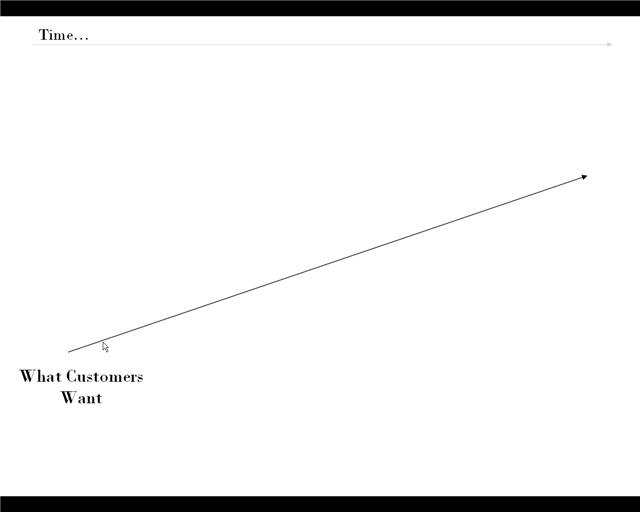
 This requires developing a deep understanding the nature of the problem that these customers are running up against – which requires talking to customers, which implies an understanding of the market dynamics, etc., etc. None of this is quick or easy. If it were, all products would be perfect and all customers would be completely happy with everything they bought. This is the hard stuff – not only because it requires real heads-down “I’m-talking-to-customers-instead-of-going-to-the-TechCrunch-party-to-generate-buzz” work, but also because it requires a high level of discipline. The discipline to ignore the press releases that say that you are falling behind your competitors, the discipline to resist implementing some really cool new emerging standard that everyone swears will be the next big thing and most importantly, the discipline to listen to what customers are saying and understanding what they really mean (and to sort out the desirable customers from the undesirable ones who tend to do all the talking).
 As Rex Hammock