
Speaking of customer service, I've been doing a lot of it today.
Customers aren't upset that our isn't working as described.
They aren't mad that it has bugs.
They aren't disappointed that we screwed things up.
They are universally dismayed when they see a lack of follow-through.
Providing our customers with answers isn't good enough. Questions are like a loaf of bread. Most of them are pretty easy to digest, but they have a shelf-life of about five days. The answers have to be correct, appropriate to the question, come in a timely manner, and so on.
Appropriately answering customers questions becomes an issue of follow-through. It means ensuring that the customer believes that the answers were appropriate, despite what the manual or process defines as appropriate. I want our staff to be concerned with what the customer thinks, not about what I think. If the customer feels that the answer was helpful and appropriate, then it probably was. The only way to guarantee that our customer feels this way is by making sure we follow-through.
I define follow-through as meaning "living up to our promises" or "doing what we'd say we'd do". In uncomplicated cases, this can be as simple as returning a phone call or sending an email. We're not doing a great job with follow-through right now. We're failing with follow-through, I believe, because we're not taking the time to pay attention to specific issues that demand unique solutions.
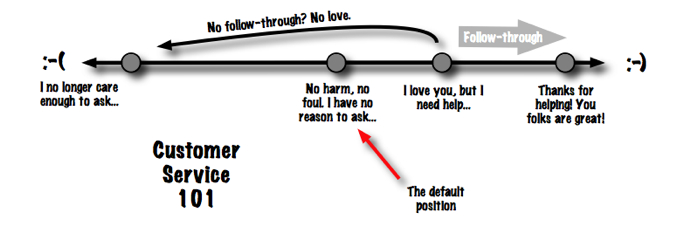
Over the years, we fell into a mode where we assumed that automation and cookie cutter responses could take care of the needs of our customers. In fact, quite the opposite has happened! For a long while, we were able to provide a pretty decent level of service with very few humans on our end of things. Our customers became more sophisticated and the online environment evolved. This should have been matched with more sophisticated systems and an evolving customer service environment on this end. But it wasn't. Instead, we tried to buck the trends and automate the heck out of everything.
It didn't work. It isn't working.
It isn't working because we don't have the right feedback loops in place. We have no real way to check if customers are making it to the righthand end of the line, and worse, we're often assuming they are when they aren't.
Providing great customer service isn't rocket science, yet so few companies do it. We're in the majority right now and I don't like it. About three months ago, we went through a real shift in terms of what we viewed as our commitment to our customers. Not surprisingly, it has little to do with automation or technology, and everything to do with soft-side fundamentals. What some would call "people skills".
We're starting to invest in better training, better people, better support systems and better practices, in order that we can make a better commitment to our customers. We will pay closer attention to the questions that are being asked, and we will work smarter on specific customer issues. Unfortunately, we're not there yet. Barely a day can go by where I don't see evidence that we've forced yet another customer to slide to the left into unhappydom.
I am hopeful that our hard fought plans will bear fruit soon, but it pains me that we haven't fully turned this corner yet. Nothing is harder than disappointing that next customer with full knowledge that it might happen.
Why am I writing this? Well, some little part of me hopes that one of those customers that we disappointed today, or yesterday or the day before, reads this and learns that even though we fell short for them, that we will do better tomorrow. I don't expect to win their business back, but I would like them to know at the very least that we do care - despite the fact that we probably didn't show it all that well.
Yeah, I know - the road to hell is paved with good intentions.


